
AI search is changing how we research and discover information online. While this is most obvious with B2C behavior—like finding the best vacuum or hotel—it’s also impacting B2B audiences. These buyers may be more discerning, but they increasingly see AI search as a smarter, more efficient way to evaluate potential vendors compared to traditional search.
So how is this shift affecting the adtech space?
There’s no shortage of guidance out there:
- More thought leadership from execs on LinkedIn or X?
- More earned media in trade publications?
- Better traditional SEO?
Unfortunately, most of the advice can’t be taken at face value. Much of it comes from conflicted players, pushing what they’re best at. That’s not necessarily bad—but, without any real research, it does create confusion around what actually works.
So, I ran a small experiment. I searched the following queries across Google and Perplexity:
- “Best DSPs for advertisers” + “Who are the best DSPs for advertisers”
- “Best SSPs for advertisers” + “Who are the best SSPs for advertisers” (Note: SSPs are increasingly going direct to buyers, so I think this search is valid.)
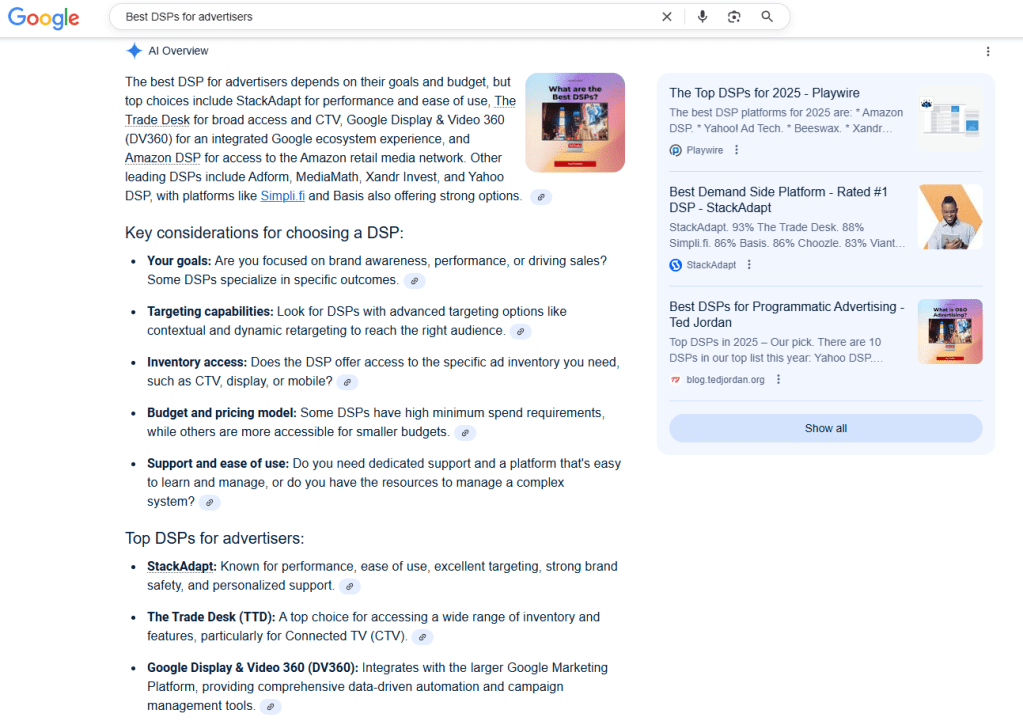
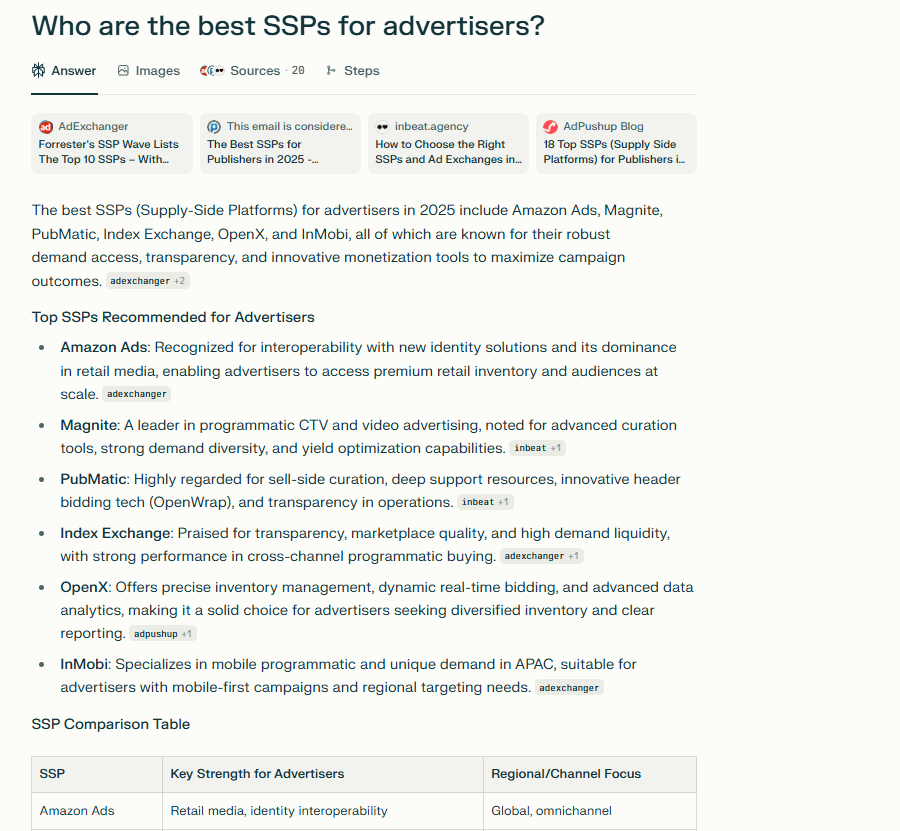
Here’s what I found, along with some PR takeaways and a possibly controversial conclusion.
The Most Influential Content: SEO-Optimized Lists + Blog Posts
The results were surprisingly dominated by a mix of company blogs and unfamiliar aggregator-style content. A few standouts:
- Adtech company Playwire showed up for both DSP and SSP queries.
- DSP StackAdapt’s own blog helped land it in AI-generated SERPs.
- Unknown (at least to me) or unexpected domains like Skydeo and Affroom ranked well.

Unsurprisingly, Reddit, YouTube, and G2 Crowd also appeared as sources. In fact, StackAdapt’s inclusion seemed driven by its G2 rating, suggesting third-party validation from the site matters.
❓ PR Takeaway: Work directly with adtech partners across the ecosystem to cross-pollinate your AI search presence. Reciprocal linking, co-created content, and shared publishing strategies matter. PR agencies can play a key role here, not just by generating press, but by strategically creating and distributing optimized content across trusted platforms. Keep in mind, a PR agency with adtech clientele can more easily open the door to other company sites and blogs for mutually beneficial cross-posting.
The Least Influential: Traditional Ad Trade Coverage
This is tough to admit as someone in PR, but traditional earned coverage in the trades didn’t seem to move the needle much. Only three pieces from major ad trades appeared in AI search results:
- One Digiday article (see the featured phrase usage, with The Trade Desk described as “the industry’s largest independent DSP”)
- One Adweek article—but it was sponsored content for Amazon Ads
- One AdExchanger article that covered a controversial SSP ranking by analyst firm, Forrester
No exec bylines appeared to be featured, and there was really no organic coverage from news publications. That, however, might simply be the result of these sites’ journalistic nature, as they rarely feature “this is the best vendor” pieces (in the AdExchanger/Forrester case, the story centered on the odd ranking).
(With that said, it will be interesting to see if, over time, advertising trades seek to optimize their ranking across AI SERP, especially across paid content to package it in their sales conversations.)
❓ PR Takeaway: If your PR partner overstates the impact of earned coverage, be skeptical. Many are still trying to preserve their legacy role as gatekeepers to media. In the new model, the best adtech PR experts will help you create search-optimized content across key platforms and support your sponsored content strategy where appropriate. Additionally, the best partners will help steer how earned coverage references a vendor to ensure optimal placement in AI SERPs down the line.
Also Weak: Social Media Content
LinkedIn and X posts were nowhere to be found in AI search results. That includes newer platforms, like Threads and Bluesky (of course). Executive or company social content is great for customer engagement, but not for discovery or prospecting—especially when buyers turn to search to find vendors.
❓ PR Takeaway: Reddit posts and YouTube content were the exceptions. They did show up in AI search results. That suggests potential value in placing strategic content on these platforms to influence discovery.
So… What Can I, a Lowly AdTech PR Guy, Do About It?
Glad you asked.
Here’s what I plan to do as an experiment—for both current and future clients—aimed at improving positioning in AI-driven search results:
🚀 1. Launch “Top Lists” on AdTechRadar
On my news site, AdTechRadar, I’ll start publishing “Best of” and “Top” vendor lists—for DSPs, SSPs, and other categories.
These lists will feature some of the companies I work with directly—but they’ll also be rounded out based on third-party research from trusted sources like Reddit, G2, and other marketplaces. The goal is to be transparent, valuable, and SEO-effective. Posts will be authentic and credibly sourced.
⭐ 2. Launch Dedicated AdTech Review Sites
I’ve also acquired the following domains (though they are not live yet):
This quarter, I’ll begin publishing authentic, searchable reviews of adtech platforms and companies (yes, companies, in addition to the technology). The goal is to help buyers discover the right partners and influence what shows up in AI and search engine results.
To be clear, these won’t be content farms. They’ll be practical, informed, authentic, and hopefully helpful. I might also enlist third-party experts to support the content.
Anyway, more to come. But in the meantime, if you’re thinking about how to shape your adtech company’s PR narrative—or influence how you’re found in an AI-first world—feel free to reach out. Let’s experiment!
—
👉 Building your adtech company’s PR program? Contact adtech PR expert Chris Harihar on X (@chrisharihar), LinkedIn, or by email.
Chris is a 15-year adtech PR expert who has helped leading companies go public and guided up-and-comers to break through in a crowded market. Clients include DoubleVerify, Yahoo DSP, and more.
 the adtech pr blog